
Zepto has expanded rapidly in India’s quick-commerce market, building a high-speed retail model around a dense dark-store network and a fast-growing customer base. But in a business where convenience carries a heavy operating cost, growth is an incomplete measure of success. The real test is whether Zepto can earn returns that justify the capital its expansion consumes.
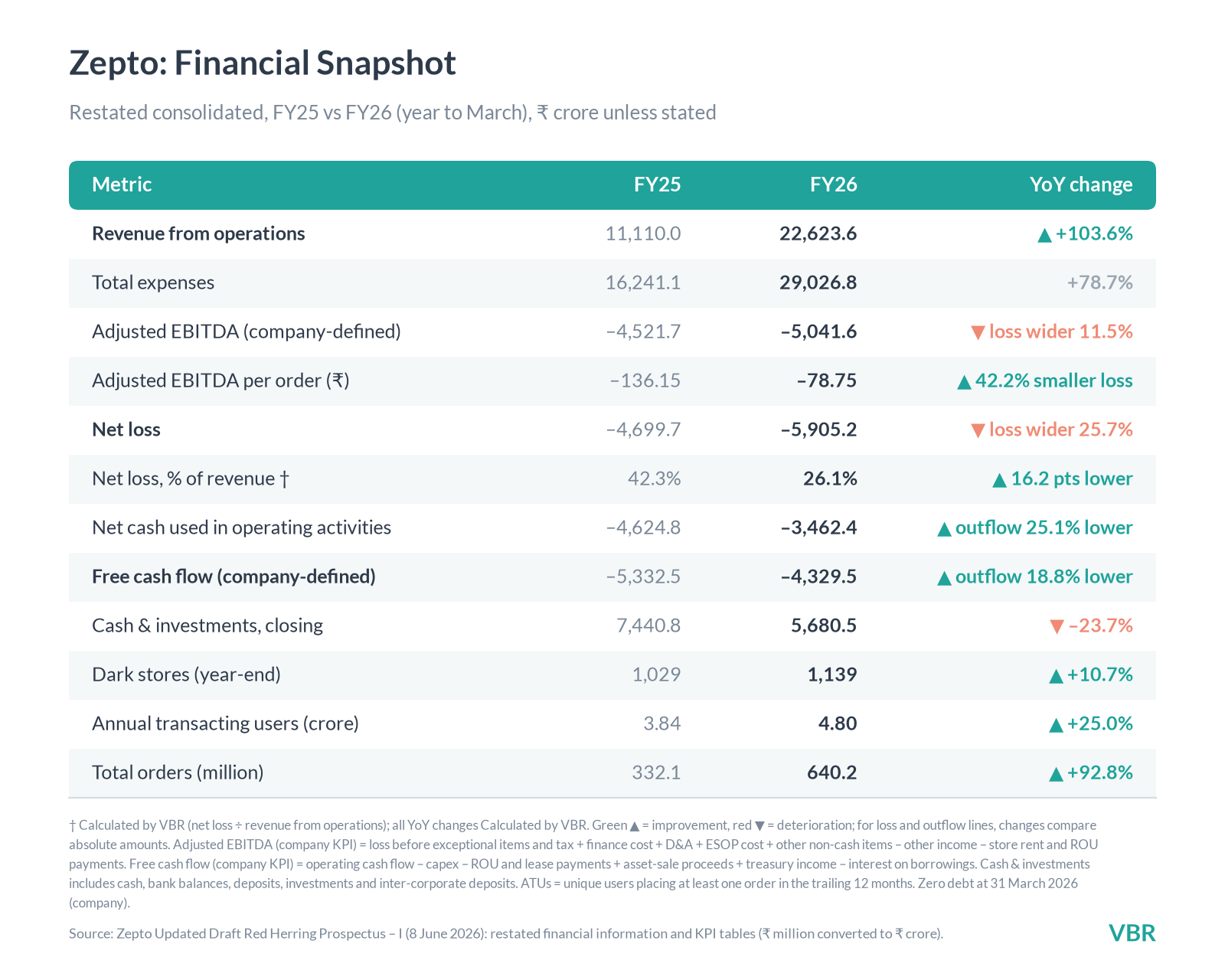
As of March 2026, Zepto ran 1,139 dark stores and counted 4.8 crore annual transacting users, according to its updated Draft Red Herring Prospectus (DRHP). That network matched Swiggy’s Instamart (1,143 stores) but was half the size of Eternal’s Blinkit (2,243), which has since grown to 2,751 stores and turned a quarterly adjusted EBITDA profit. Scale is not the same as sustainability: the network demands constant spending on logistics, technology, warehousing and customer acquisition.
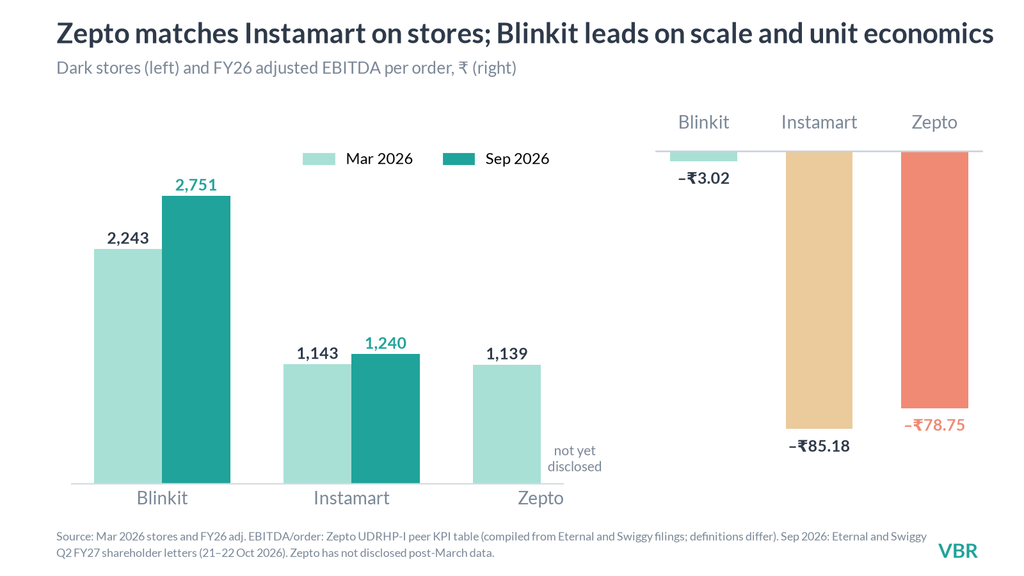
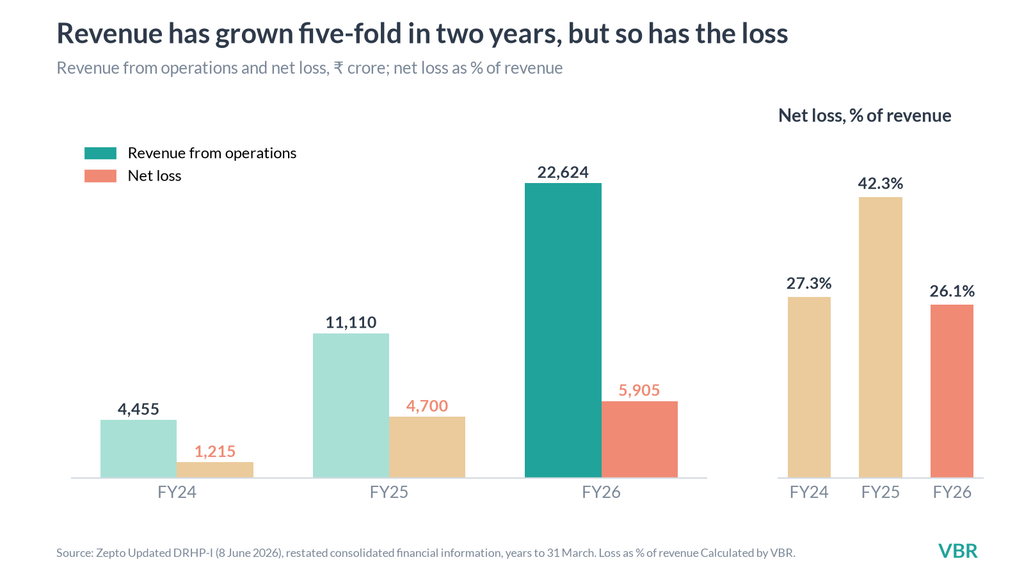
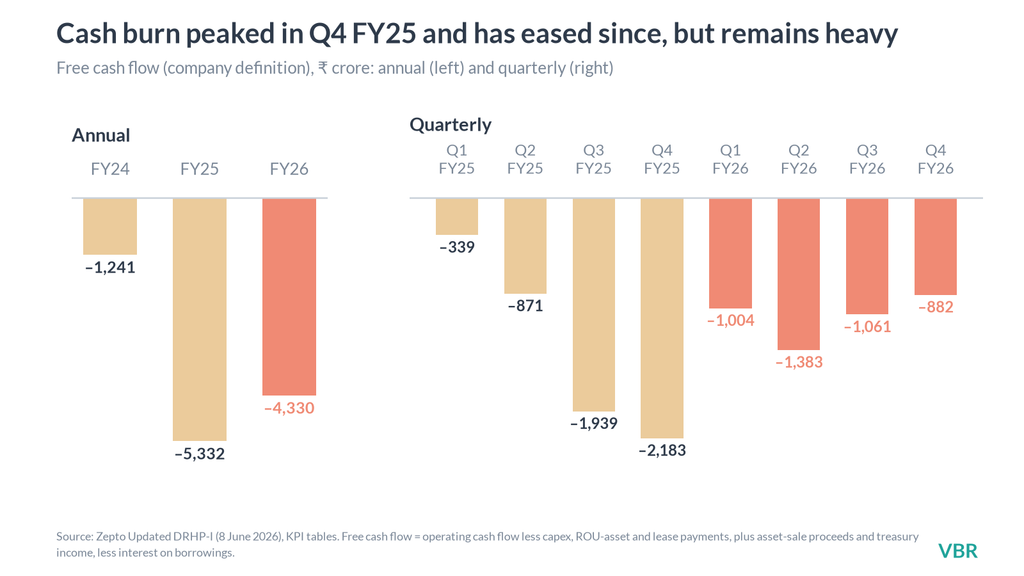
The FY26 results show the gap. Revenue from operations more than doubled to ₹22,623.58 crore from ₹11,109.95 crore, yet the net loss widened to ₹5,905.19 crore from ₹4,699.71 crore. There are signs of operating leverage: the loss fell to 26% of revenue from 42%, and the adjusted EBITDA loss per order almost halved to ₹78.75 from ₹136.15. Free cash flow, which Zepto defines as operating cash flow minus capital expenditure and lease payments, adjusted for treasury income and interest, improved to minus ₹4,329.54 crore from minus ₹5,332.49 crore. Even so, the business is still consuming cash: cash and investments fell to ₹5,681 crore from ₹7,441 crore over the year.
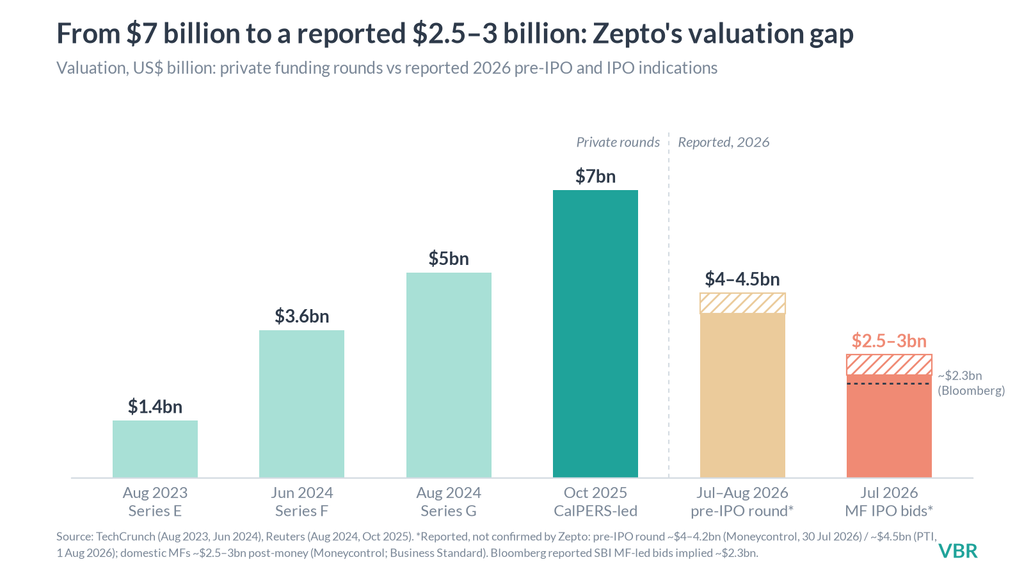
These economics matter as Zepto pursues a listing. After SEBI cleared its confidential filing in May, it filed updated draft papers in June 2026, proposing a fresh issue of up to ₹8,010 crore plus an offer for sale by existing shareholders. It then put the IPO on hold amid reported differences over valuation. Domestic mutual funds were reportedly willing to value the company at about $2.5–3 billion, against roughly $4–4.5 billion reported for its pre-IPO round and the $7 billion it commanded privately in October 2025. These were reported negotiations, not an agreed price.
On 1 August 2026, Zepto announced a primary pre-IPO private placement with major shareholders, without disclosing its size; reports put it at more than ₹1,000 crore. The company said it would update its financials and list within the validity of its SEBI-approved papers, which reportedly runs until November 2027. Chief executive Aadit Palicha had reportedly told staff a day earlier that the target was two to three quarters, depending on performance and market conditions. As of late October 2026, Zepto had published neither updated financials nor a listing date.
Zepto’s investment case rests on turning scale into financial results. Its customer base proves demand; its widening loss shows the cost of serving it; its negative free cash flow shows how much capital expansion still requires. The IPO delay shows that investors are pricing exactly these questions. The challenge is no longer simply to grow, but to prove that growth can earn returns commensurate with the capital it consumes.
Be the first to comment