
India’s natural gas market is moving towards a more transparent and market-driven structure, and the Indian Gas Exchange (IGX) sits at the centre of that transition. Launched in June 2020 and authorised by the Petroleum and Natural Gas Regulatory Board (PNGRB) later that year, IGX is India’s first and only authorised national-level physical-delivery gas exchange. It functions much like a stock exchange, except that the underlying commodity is natural gas.
| Metric | FY24 | FY25 | FY26 |
|---|---|---|---|
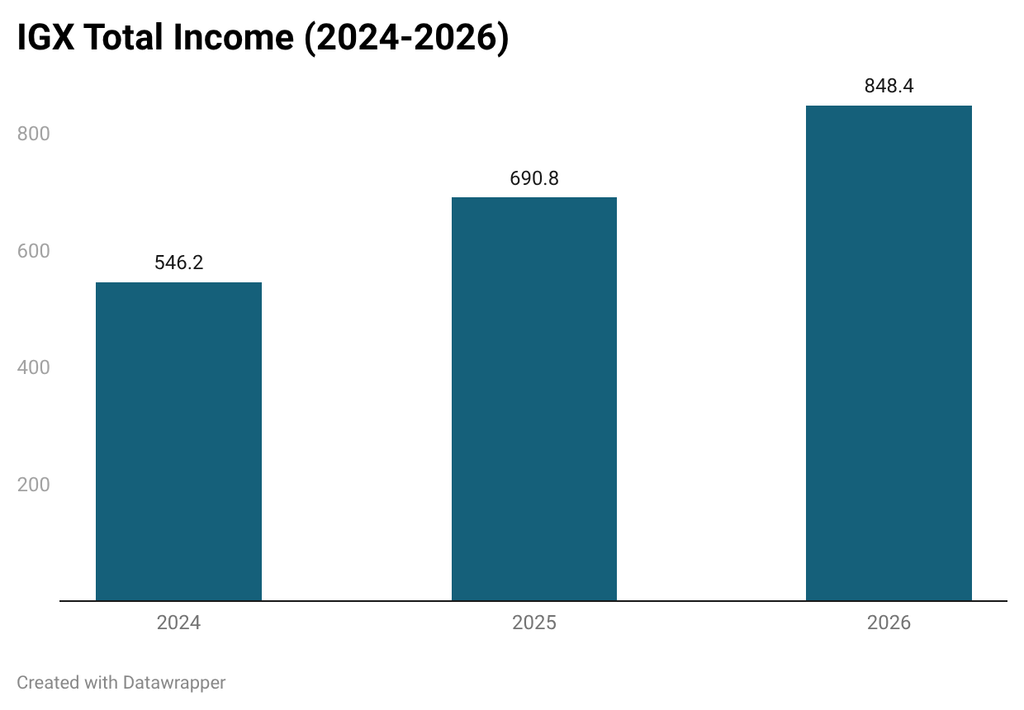
| Total Revenues | 546.19 | 690.82 | 848.39 |
| Revenue Growth (%) | -11.90% | 26.50% | 22.81% |
| EBITDA | 339.16 | 462.42 | 584.55 |
| EBITDA Margin (%) | 97.33% | 94.44% | 96.07% |
| Profit After Tax (PAT) | 231.09 | 309.59 | 419.27 |
| PAT Margin (%) | 42.30% | 44.80% | 49.40% |
| PAT Growth (%) | -17.70% | 34% | 35.43% |
| Net Profit Ratio (%) | 66.14% | 63.41% | 68.63% |
| Current Ratio | 1.62 | 1.8 | 1.51 |
| ROE (%) | 21.94% | 23.41% | 25.63% |
| ROCE (%) | 26.96% | 27.76% | 31.62% |
IGX does not produce or transport gas. Instead, it provides an electronic marketplace where producers, city gas distributors, power companies and other gas consumers can trade standardised contracts. Physical delivery through India’s pipeline network makes IGX an important mechanism for price discovery, transparency and liquidity.
That marketplace is gaining scale. In FY26, IGX traded 76.79 million MMBtu, up from around 60 million MMBtu in FY25. Revenue rose about 25% to ₹61 crore, while net profit increased 36.5% to ₹42 crore. Yet IGX still accounts for only around 2.8% of India’s total gas consumption, highlighting the headroom for further growth.
That opportunity is tied closely to India’s expanding gas market. Consumption is currently around 190 MMSCMD, while PNGRB projects demand could reach roughly 297 MMSCMD by 2030 under its growth scenario. Expansion of city gas distribution, fertiliser, industrial and power demand, supported by new pipelines and LNG terminals, could widen IGX’s addressable market. At the same time, India’s dependence on imported LNG leaves the market exposed to global prices and geopolitical disruptions.
Against this backdrop, the IPO is the next major milestone. IGX filed its Draft Red Herring Prospectus (DRHP) with SEBI in July 2026 and is targeting a listing by December 2026, subject to approvals and market conditions. The issue is entirely an Offer for Sale (OFS), with IEX planning to sell up to 1.67 crore shares, reducing its stake from about 47.3% to 25%. No fresh capital will go to IGX. Market estimates place the potential IPO at around ₹600–700 crore, although the final issue size and price remain undecided.
The outlook is structurally positive but not risk-free. India’s rising gas consumption and the gradual shift towards organised trading could allow IGX to capture a larger share of gas trading. Regulation, infrastructure constraints, LNG price volatility and geopolitical shocks remain key risks. The IPO is therefore less a fundraising story than a public-market bet on the formalisation and expansion of India’s natural gas market.
Be the first to comment