
HDFC Bank: Merger pangs, governance & more

MetricValue
Market Cap (₹ Cr) ₹  11,13,174.00
ROCE (%)6.92%
Current Ratio2.35%
ROE (%)14%
Return on Assets (%)1.8%
Debt to Equity6.28
Branches9694
NIM (%)3.26%
Cost to Income Ratio (%)39.2%

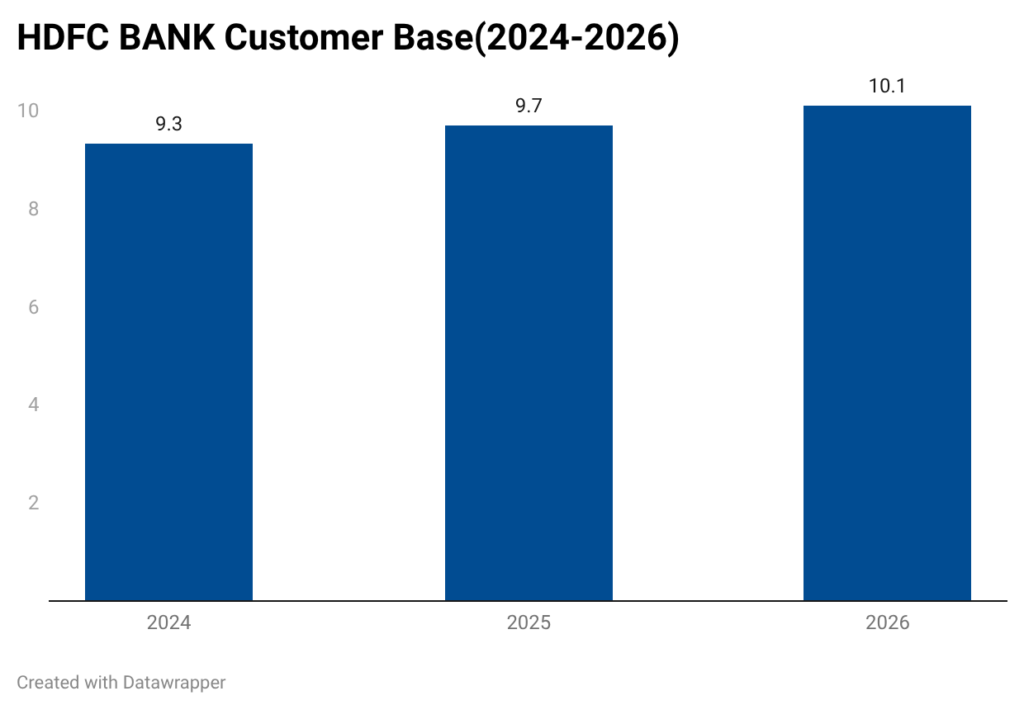
For years, HDFC Bank was the benchmark every Indian private bank aspired to match. Renowned for its disciplined lending, strong asset quality and consistent profitability, it spent more than two decades setting the standard for banking excellence. Today, the conversation around HDFC Bank has changed. While it remains India’s largest private sector bank with assets exceeding ₹49 lakh crore, more than 120 million customers, and one of the country’s most extensive banking networks investors are now closely watching whether its biggest strategic bet, the 2023 merger with HDFC Ltd, can translate into stronger long-term growth despite short-term pressure on profitability.
Between 2015 and 2022, HDFC Bank firmly established itself as the “gold standard” of Indian banking. It consistently delivered Net Interest Margins (NIMs) above 4%, Return on Assets (RoA) of around 2%, Return on Equity (RoE) exceeding 16–18%, and one of the lowest Gross NPA ratios among large banks. While peers such as Axis Bank and several public sector banks spent years repairing stressed corporate loan books, HDFC Bank continued to grow without compromising credit quality. Its predictable earnings and disciplined underwriting earned it premium market valuations and made it the benchmark against which every major private lender including ICICI Bank was measured.

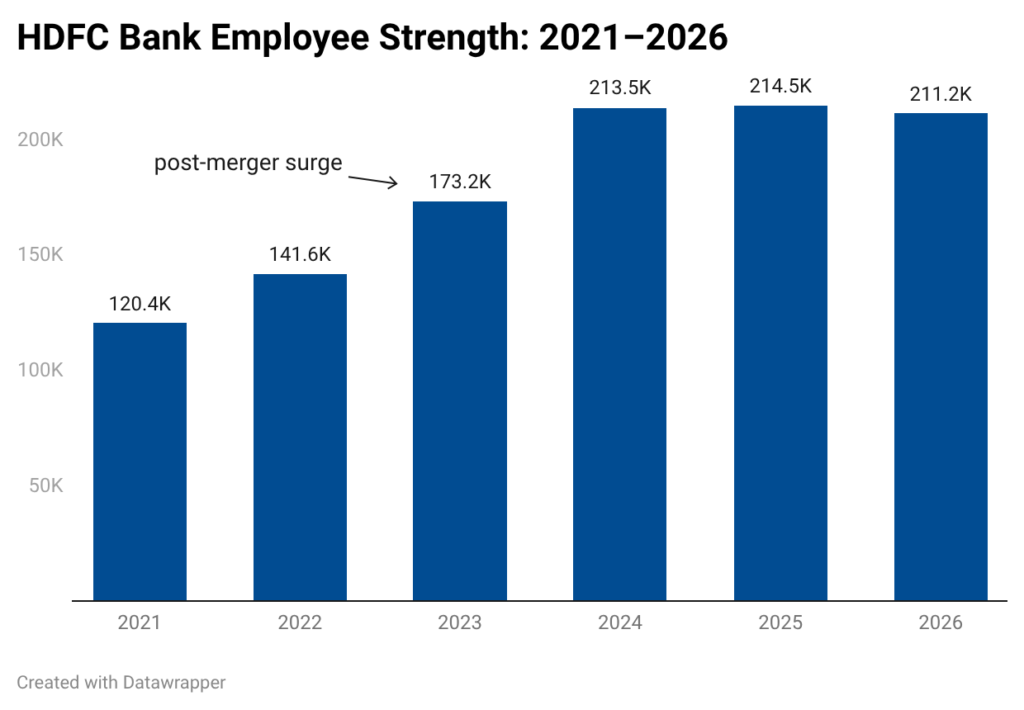
The defining moment in the bank’s history came on 1 July 2023, when it completed its historic merger with HDFC Ltd, India’s largest housing finance company. Valued at nearly US$40 billion, the transaction became the largest corporate merger in India’s banking history. Beyond adding scale, the merger transformed HDFC Bank into a universal financial institution, bringing banking, housing finance, insurance, wealth management and investment products under one integrated platform.

However, integrating two institutions of such scale fundamentally altered the bank’s financial profile. HDFC Bank inherited HDFC Ltd’s higher-cost borrowings and a large portfolio of lower-yielding mortgage loans, resulting in a significantly elevated Credit-Deposit (CD) ratio. Management has repeatedly identified this as the key constraint on loan growth, as the bank must first accelerate deposit mobilisation before expanding lending at its historical pace. The bank has guided that normalising the CD ratio is likely to be a multi-year exercise extending through FY27 and beyond.

These structural changes were reflected in Q1 FY27. HDFC Bank reported net profit of ₹19,060 crore, up 5% year-on-year, while advances grew 15.4%. However, the headline profit growth appears stronger than the underlying performance because the corresponding quarter last year included a one-time gain from the partial listing of HDB Financial Services, making year-on-year comparisons less straightforward. More concerning for investors was the decline in Net Interest Margin (NIM) to 3.26%, the lowest in the bank’s history, reflecting elevated funding costs and merger-related adjustments. By comparison, ICICI Bank reported a NIM of approximately 4.36% during the same period, highlighting the profitability gap that has emerged between India’s two largest private-sector lenders. Following the results, HDFC Bank’s shares fell nearly 5%, as investors questioned how quickly margins could recover.

Management argues that the current pressure is temporary rather than structural. As the bank improves its deposit franchise and gradually brings down the CD ratio, reliance on expensive wholesale borrowings should reduce, supporting margin recovery over the next few years. The larger customer base created through the merger more than 120 million customers supported by nearly 9,700 branches and around 21,000 ATMs across the country—is also expected to unlock meaningful cross-selling opportunities across savings accounts, mortgages, insurance, mutual funds and wealth management, increasing customer lifetime value while improving operating leverage.

Despite the near-term challenges, HDFC Bank continues to retain significant structural strengths. Its Gross Non-Performing Asset (GNPA) ratio of around 1.2% remains among the best in the industry, capital adequacy remains comfortably above regulatory requirements, and its designation as a Domestic Systemically Important Bank (D-SIB) by the Reserve Bank of India reflects its systemic importance. The bank is also accelerating its “HDFC 2.0” strategy under Managing Director and CEO Sashidhar Jagdishan, with over 50,000 employees trained in Generative AI and Microsoft Copilot deployed to nearly 20,000 employees. Artificial intelligence is increasingly being integrated into credit underwriting, fraud detection, customer engagement and operational processes to improve efficiency and strengthen long-term competitiveness.

Yet the investment case is no longer as straightforward as it once was. Before the merger, HDFC Bank was valued primarily for its consistency and superior profitability. Today, investors are assessing whether the benefits of scale can outweigh the costs of integration. Key questions remain around the pace of CD ratio normalisation, deposit mobilisation, restoration of historical RoE, competitive pressure from peers such as ICICI Bank and Axis Bank, and the successful delivery of merger synergies. While management remains confident that the integration will unlock long-term value, the timeline and magnitude of those benefits will ultimately determine whether HDFC Bank can reclaim its position as the undisputed benchmark of Indian private banking.

Be the first to comment

Leave a Reply

Your email address will not be published.


*