
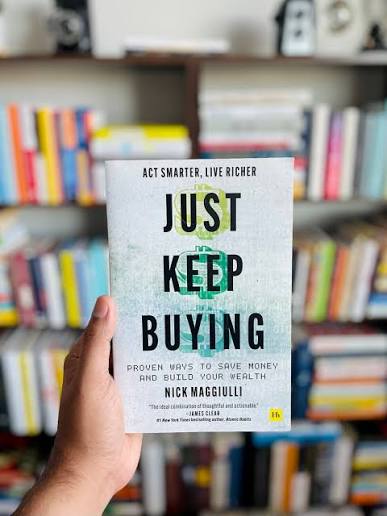
Nick Maggiulli’s Just Keep Buying: Proven Ways to Save Money and Build Your Wealth takes a data-driven approach to one of personal finance’s biggest questions: how can ordinary investors build wealth without constantly trying to predict the market? Published in 2022, the book argues that consistent saving, investing and disciplined financial behaviour matter more than perfect market timing. Broadly divided into saving and investing, it explains that early in life, increasing income and building savings can matter more than investment returns because the initial investment corpus is relatively small. Rather than obsessing over minor expenses, Maggiulli encourages readers to focus on growing their earning power while saving according to their circumstances.
Maggiulli also takes a pragmatic approach to spending. He challenges extreme frugality and argues that money can improve quality of life when spending is intentional. His “2x Rule” encourages readers to balance discretionary purchases by investing an equivalent amount, reflecting the book’s broader attempt to reconcile financial discipline with present-day spending. On investing, the title captures its central philosophy: keep buying productive assets consistently rather than waiting for the perfect market entry. Through historical data, Maggiulli challenges market-timing strategies and examines lump-sum investing versus dollar-cost averaging, showing why lump-sum investing has historically tended to outperform investing the same available capital gradually over time. He favours diversified index funds over individual stock picking and stresses automation, diversification and long-term investing.
One of the book’s biggest strengths is its data-first approach. Maggiulli uses historical market data, statistics, charts and financial scenarios to examine saving, spending, market timing and investment returns. These examples make complex concepts accessible without turning the book into a technical textbook, while strengthening the credibility of its arguments. Its conversational writing style also makes subjects such as compounding, debt, housing and retirement easier to understand. Its behavioral focus is another strength, particularly its argument that emotional decisions can be more damaging than short-term market volatility. The practical nature of its advice makes it particularly accessible to beginners and intermediate investors.
However, the book has limitations. Its analysis is largely US-centric, with many examples, financial systems and investment assumptions reflecting American markets, which can limit its direct applicability to readers elsewhere. Experienced investors may also find several principles familiar, particularly those already comfortable with passive investing, diversification and behavioral finance. The book is not intended to be a personalized investment roadmap and does not provide deep technical treatment of portfolio construction or tax strategies across different countries. Some ideas recur throughout the book, which can make certain sections feel less concise, although this repetition also supports its emphasis on behavioral consistency.
Ultimately, Just Keep Buying succeeds because it turns personal finance into a discipline rather than a prediction game. For beginners and intermediate investors, its value lies in making financial behaviour actionable; for experienced investors, it may reinforce the discipline required to follow familiar principles consistently. The book’s core message is straightforward: save according to your circumstances, increase your earning power, invest consistently and give compounding time to work.
Be the first to comment