
EV Policy in a Snapshot
| Policy / Scheme | Budget / Incentive | Objective | Key Impact |
| Key Impact | ₹10,900 Cr | Accelerate EV adoption | Vehicle subsidies & charging infrastructure |
| GST on EVs | 5% | Reduce ownership cost | Lower than 28% GST on ICE vehicles |
| Section 80EEB | ₹1.5 Lakh Tax Deduction | Encourage EV financing | Tax benefit on EV loan interest |
| PLI Auto Scheme | ₹25,938 Cr | Domestic EV manufacturing | Localize EV ecosystem |
| ACC Battery PLI | ₹18,100 Cr | Battery manufacturing | Reduce battery imports |
| Delhi EV Policy 2.0 | Up to ₹1 Lakh Incentive | Boost EV adoption | Road tax & registration fee exemption |
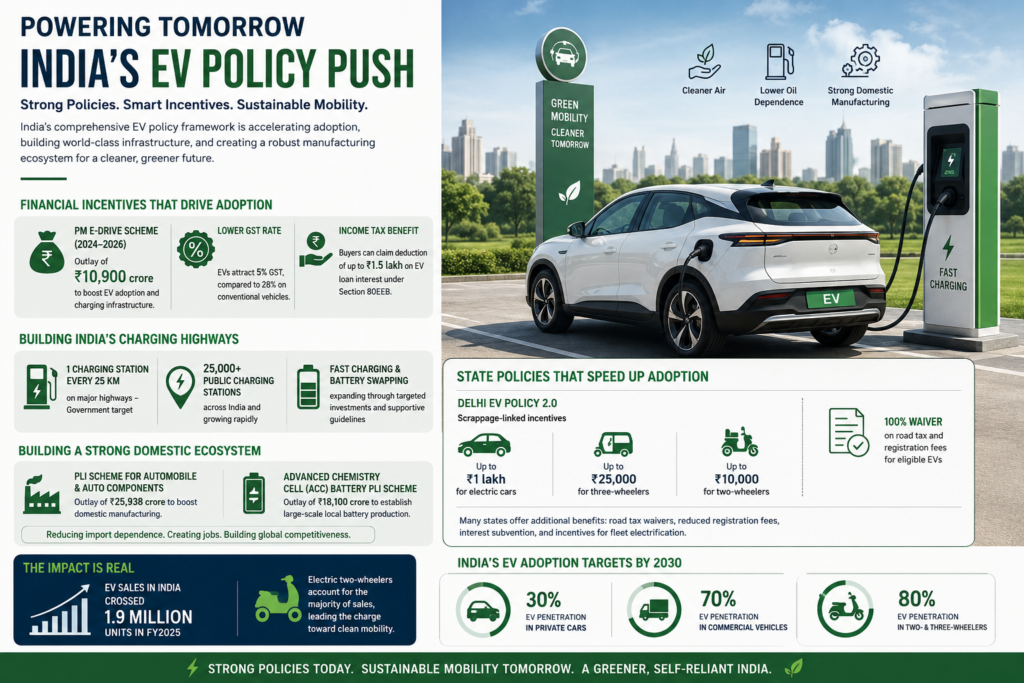
India’s Electric Vehicle (EV) policy framework is supported by significant financial commitments and measurable adoption targets. Under the PM E-DRIVE Scheme (2024–2026), the government has allocated approximately ₹10,900 crore to accelerate EV adoption and charging infrastructure development. EVs attract a reduced GST rate of 5%, compared to 28% on conventional vehicles, while buyers can claim income tax deductions of up to ₹1.5 lakh on EV loan interest under Section 80EEB.
Infrastructure expansion remains a key priority. Government guidelines target at least one public charging station every 25 km on major highways, supported by investments in thousands of fast-charging points and battery-swapping facilities. India’s public charging network has grown rapidly, crossing 25,000+ charging stations nationwide, with further expansion planned.
To strengthen domestic manufacturing, the government launched the PLI Scheme for Automobile and Auto Components, with an outlay of ₹25,938 crore, alongside the Advanced Chemistry Cell (ACC) Battery PLI Scheme worth ₹18,100 crore. These initiatives aim to reduce import dependence and establish large-scale local battery production.
Volume growth is picking and likely to enter fast lane
State governments further enhance adoption through road tax and registration fee waivers, scrappage incentives, and fleet electrification mandates. For instance, Delhi EV Policy 2.0 offers scrappage-linked incentives of up to ₹1 lakh for electric cars, ₹25,000 for three-wheelers, and ₹10,000 for two-wheelers, while maintaining 100% road tax and registration fee exemptions for eligible EVs.
Driven by these policies, EV sales in India surpassed 1.9 million units in FY2025, with electric two-wheelers accounting for the majority of sales. The government aims to achieve 30% EV penetration in private cars, 70% in commercial vehicles, and 80% in two- and three-wheelers by 2030, highlighting the scale of India’s transition toward electric mobility.
Be the first to comment