
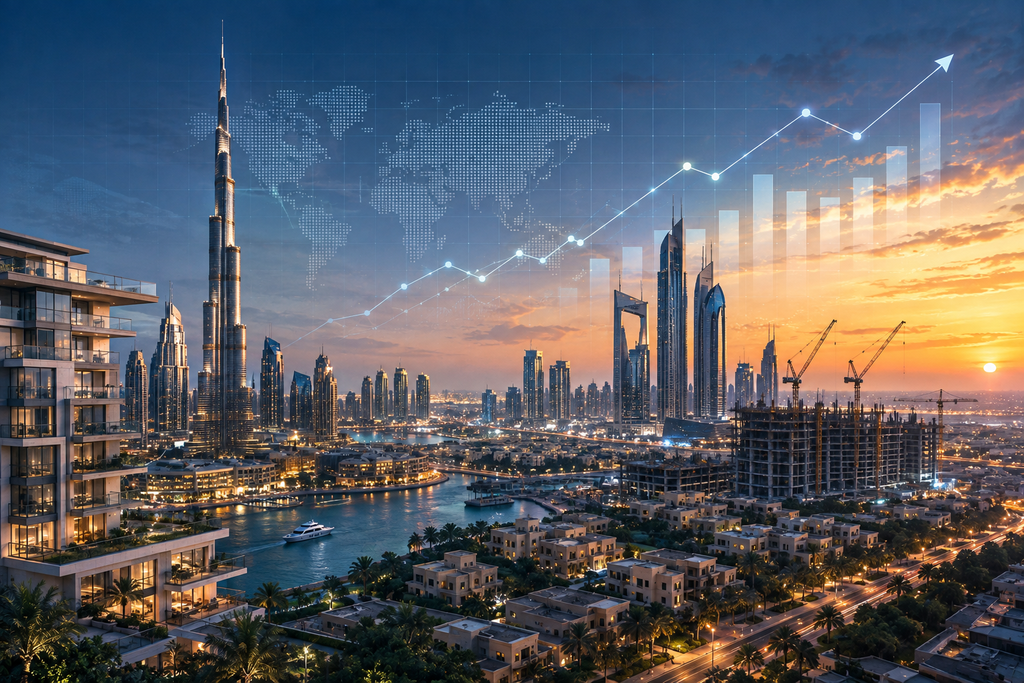
The Middle East’s real estate market has been one of the region’s biggest economic stories over the past two years. Dubai has led the surge, supported by population growth, tourism, international investment, infrastructure and large-scale development. But with residential activity beginning to moderate, the key question is whether the boom is ending or simply entering a more selective phase.
Dubai recorded AED286.43 billion (around $78 billion) in property sales in H1 2026, according to Dubai Land Department data. A separate residential-market dataset from Cavendish Maxwell reported about 79,200 residential transactions worth AED221.3 billion, with transaction volumes down 13.8% and values down 15.7% from H1 2025. These figures are not directly comparable: the DLD figure covers the wider property market, while the Cavendish Maxwell data specifically tracks residential transactions. That distinction is important when interpreting Dubai’s headline numbers.
The moderation does not necessarily signal a collapse. Commercial, branded and ultra-prime properties continue to attract demand, while mainstream residential activity is normalising from exceptionally strong levels. The shift therefore appears less like a broad reversal and more like a rotation within the market, as investors become more selective about property types and locations.
Saudi Arabia is following a different trajectory, with real estate closely linked to Vision 2030, infrastructure investment and large-scale development programmes. Riyadh’s Grade A office market recorded 97% occupancy in Q1 2026, reflecting strong demand and limited high-quality supply. Qatar’s smaller market, meanwhile, has been shaped by post-World Cup infrastructure development and gradual liberalisation of foreign property ownership. The Gulf, therefore, cannot be treated as a single, uniform property market.
The longer-term outlook remains positive, supported by economic diversification, population growth, tourism, residency programmes and favourable tax conditions. But rising property prices must be matched by rents, incomes and genuine occupier demand. If valuations rise faster than these fundamentals, rental yields and investor returns could come under pressure.
The evidence therefore points less to the end of the Gulf property boom than to a more selective phase, where the sustainability of returns will increasingly depend on whether rents, incomes and genuine end-user demand can keep pace with property valuations.
Be the first to comment