
When Reliance Jio commercially launched in 2016, it did far more than enter India’s telecom market it fundamentally disrupted it. At a time when mobile data remained expensive and internet penetration was limited, Jio introduced free voice calls and ultra-low-cost data, triggering one of the most significant transformations in India’s digital economy. What began as an aggressive telecom entry rapidly evolved into a nationwide digital revolution, forcing incumbents to slash tariffs, accelerating 4G adoption, and bringing millions of Indians online for the first time.
In less than a decade, Jio has transformed from a telecom operator into India’s largest digital services platform, serving over 520 million subscribers and accounting for nearly 50% of the country’s wireless subscriber base. The company generates annual revenues exceeding ₹1 lakh crore and has built one of the world’s largest 4G and 5G networks, with over 250 million 5G users. Its rapid scale-up reflects not only market penetration but also Jio’s central role in India’s broader digital transformation.
Jio’s business model is built on a simple yet highly scalable principle: acquire customers through affordable connectivity and monetize them through a broad digital ecosystem. While mobile services remain the core business, the company has steadily expanded into broadband, cloud computing, enterprise solutions, artificial intelligence, digital advertising, and entertainment. Its broadband platforms JioFiber and JioAirFiber now connect more than 25 million homes and businesses, creating a fast-growing recurring revenue stream.
A defining strength of Jio lies in ecosystem integration. Through platforms such as JioHotstar, JioTV, cloud offerings, digital applications, and partnerships with more than 15 OTT platforms, the company increases user engagement while reducing churn. This enables Jio to monetize not just connectivity, but also content consumption, subscriptions, advertising, and enterprise-grade digital services.
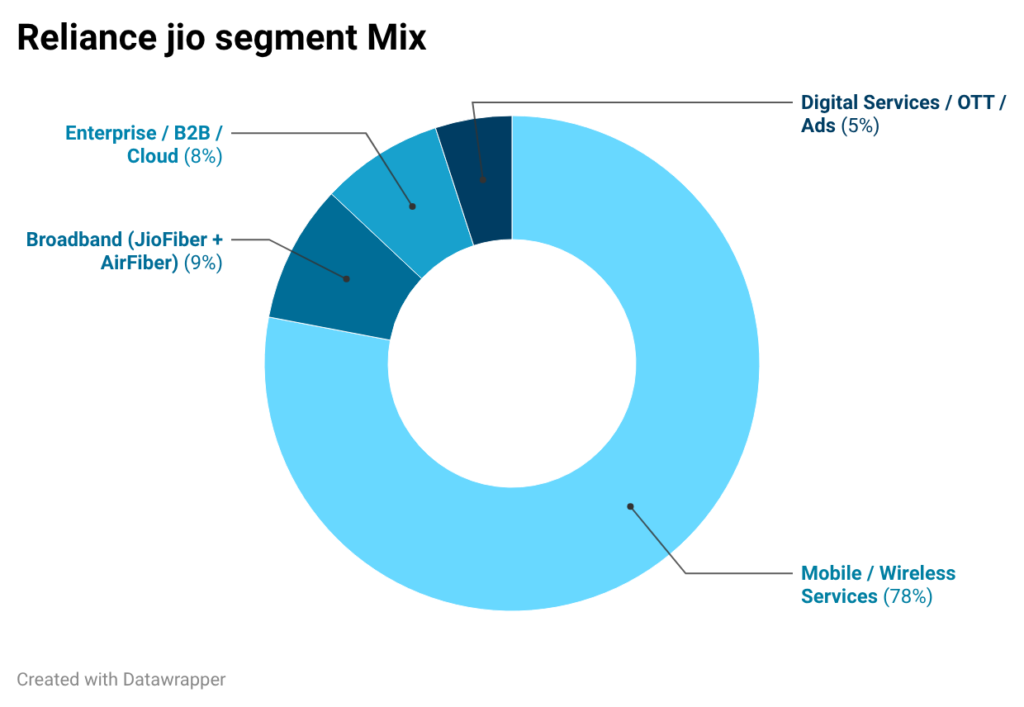
Reliance Jio also benefits from significant economies of scale, supported by one of India’s largest fiber networks and extensive spectrum holdings. Its massive user base allows infrastructure costs to be spread across hundreds of millions of subscribers, strengthening profitability and creating powerful competitive advantages. In effect, Jio no longer operates merely as a telecom company it functions as a platform business where connectivity acts as the gateway to a much larger ecosystem spanning technology, entertainment, cloud infrastructure, AI, and enterprise services.
Today, Jio stands at a critical strategic inflection point. Having established itself as the backbone of India’s digital infrastructure, the next phase of growth may increasingly come from higher-margin digital businesses such as AI services, cloud platforms, enterprise software, and data-center infrastructure.
This naturally raises one of the most anticipated questions in Indian capital markets: When will Jio finally go public? With market valuation estimates ranging between $120–180 billion, a potential Jio IPO could become one of the largest in India’s history. If listed, it would not merely be a telecom IPO it would represent the public market debut of one of India’s most influential digital platform businesses.
The bigger question may no longer be whether Jio will launch an IPO, but whether investors are about to witness the listing of India’s next true technology giant.
Be the first to comment