

Telecommunications is the super critical infrastructure now and has moved beyond just transmitting voice and data. Video streaming, digitally completed transactions, e-Commerce and entire ecosystem build on this core infrastructure makes telecom and backbone of digital India initiative. This infrastructure is built with the hardware of mobile networks, broadband, fibre-optic networks, telecom towers, satellites, submarine cables, data centres, IoT and enterprise networks, making it an increasingly important foundation for India’s digital economy. The sector operates under the Telecommunications Act, 2023, with the Department of Telecommunications (DoT) responsible for policy, authorization and spectrum administration, while TRAI oversees areas such as consumer protection, tariffs, quality of service and competition. In 2026, DoT introduced the Telecommunication Authorization Rules, replacing the legacy licensing framework with an authorization-based system designed to simplify and modernise telecom operations.
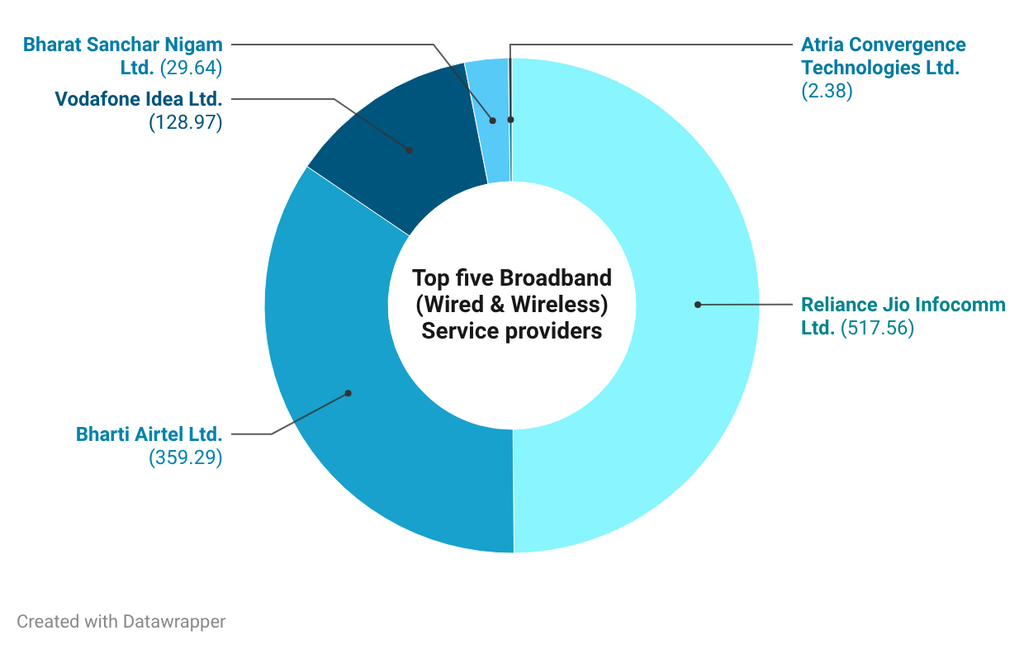
The government’s objective goes beyond expanding connectivity: its push for domestic telecom manufacturing is also a strategic response to dependence on imported network equipment, with local capabilities potentially strengthening supply-chain resilience while creating opportunities for Indian companies to develop technology, intellectual property and exports. India’s telecom market is increasingly concentrated around Reliance Jio and Bharti Airtel, while Vodafone Idea and BSNL remain smaller but strategically important players. As of April 2026, Jio held 39.25% and Airtel 37.81% of India’s wireless subscriber market, giving the two operators a combined 77.06% share.
The wider ecosystem includes tower companies, fibre providers, network-equipment manufacturers, cloud platforms and data centres. However, subscriber growth alone does not determine profitability. For operators, the revenue equation is driven by ARPU and subscriber numbers, while the cost side includes spectrum payments, network CAPEX, towers, fibre, energy and operating expenses. Rising data consumption can improve network utilisation, but tariff increases, higher ARPU and enterprise revenues are increasingly important for converting that usage into sustainable returns. Key monetisation opportunities include enterprise connectivity, private 5G, IoT, fixed wireless access and cloud-linked services. Telecom infrastructure operates through an interconnected chain of spectrum → towers and base stations → fibre backhaul → core networks → cloud and data centres → applications, with each layer requiring substantial investment. The sector’s three major constraints are CAPEX and spectrum costs, fibre and backhaul expansion, and the ability to generate adequate returns from 5G investment. Rural connectivity can also be commercially difficult, while cybersecurity, energy consumption and dependence on foreign technology add further risks. As data traffic rises, operators therefore face the challenge of expanding capacity without allowing infrastructure costs to outpace revenue growth.
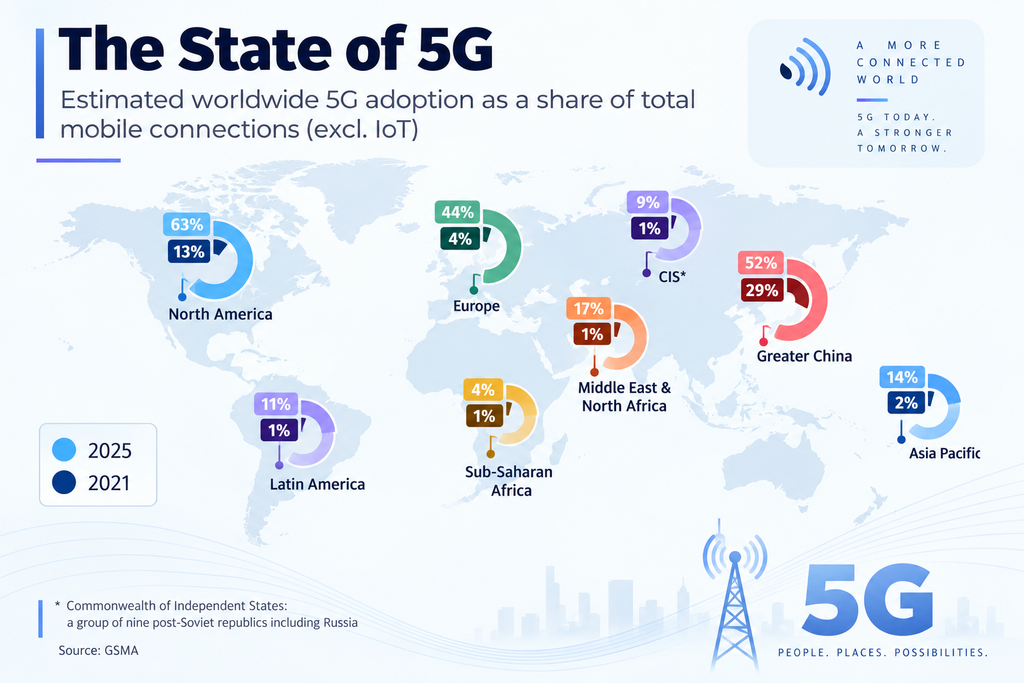
India commercially launched 5G in October 2022 and has expanded it rapidly. As of February 28, 2026, 5G was available in 99.9% of India’s districts, with 5.23 lakh 5G base transceiver stations installed nationwide. The significance of 5G extends beyond faster smartphone downloads: higher speeds, lower latency and greater device capacity are enabling applications across smart manufacturing, healthcare, agriculture, logistics and IoT, while fixed wireless access can expand broadband without requiring fibre to every premises.
However, deployment success does not automatically translate into financial success. India has demonstrated that it can deploy 5G at scale; the harder question is whether operators can generate sufficient incremental revenue from that investment, making monetisation rather than merely coverage of the next phase of the sector. These opportunities include enterprise connectivity, private 5G, IoT, fixed wireless access and cloud-linked services. Meanwhile, 6G remains under development, but India is already building the research base needed to influence the technology. As of February 2026, the government had approved 104 6G research and development projects worth ₹271 crore under the Telecom Technology Development Fund, alongside the Bharat 6G Vision Document and a spectrum roadmap covering 2025–2035.
This indicates that India’s ambition extends beyond adopting future networks: it is attempting to develop domestic technologies, participate in global standards and build intellectual property that could eventually support exports and global competitiveness. Looking ahead, telecom will increasingly converge with AI, cloud computing, data centres, semiconductors and satellite communications. The sector’s biggest question is no longer whether India can build networks at scale, but whether operators and technology companies can convert that connectivity into higher ARPU, stronger enterprise revenues and adequate returns on heavy capital investment. At the same time, domestic technology development will determine whether India remains primarily a major telecom market or evolves into a producer of globally competitive telecom technology and intellectual property. Its ability to influence global 6G standards will be an important part of that transition.
Be the first to comment