
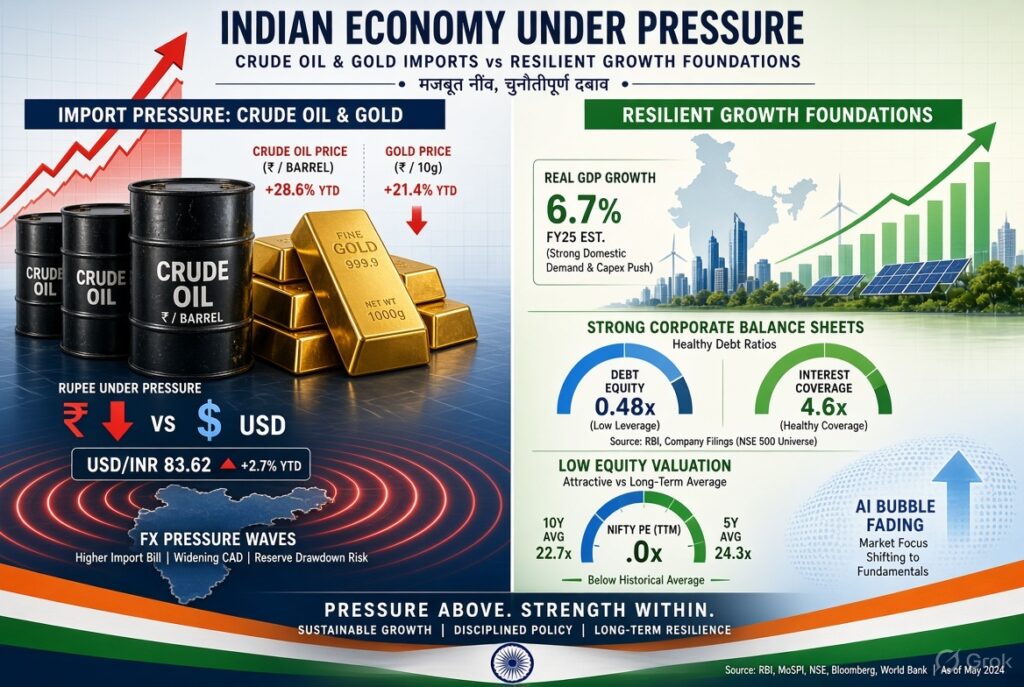
India’s economy remains closely tied to crude oil and gold prices. As one of the world’s largest importers of both, with crude dependence stuck near 88.1%, sharp rises quickly inflate the import bill. In the first half of FY27, India paid $90.6 billion for virtually the same volume of crude (122.7 million tonnes) as a year earlier—up 46% from $61.9 billion—while the net oil-and-gas bill climbed to $81.1 billion. Gold imports, though down 27% to $19.27 billion after the duty hike, still add to the pressure.
In the medium term this creates clear FX strain. The current-account deficit widened to $4.2 billion (0.5% of GDP) in Q1 FY27, the rupee tested record lows near 96–97 per dollar, and foreign-exchange reserves fell from a peak of roughly $786 billion in early September to about $726 billion by mid-October as the RBI intervened. Corporate earnings also feel the pinch: higher input costs compress margins, especially in energy-intensive sectors, while a weaker rupee and tighter financial conditions weigh on profitability.
Yet India has repeatedly shown it can absorb such shocks over the longer horizon. Past episodes of equity, currency and fixed-income volatility, as well as periods of slower earnings and balance-sheet stress, were eventually digested through policy buffers, resilient domestic demand and gradual structural reforms.
Today the underlying foundations look constructive. Nifty 50 trades at a trailing PE of around 19.3×—comfortably below its five-year median of roughly 22×—while corporate balance sheets remain healthy: median debt-to-equity has fallen to about 0.5× and interest-coverage ratios stay robust near 6.5×. Rating upgrades continue to outpace downgrades. At the same time, the global AI-driven valuation boom shows clear signs of peaking, with market corrections and growing warnings from institutions and investors. These factors, together with solid domestic demand, suggest that near-term commodity-driven volatility need not derail India’s medium-to-long-term growth trajectory. The economy has weathered worse shocks before; its current balance-sheet strength and valuation cushion leave it better placed to do so again.
Be the first to comment