
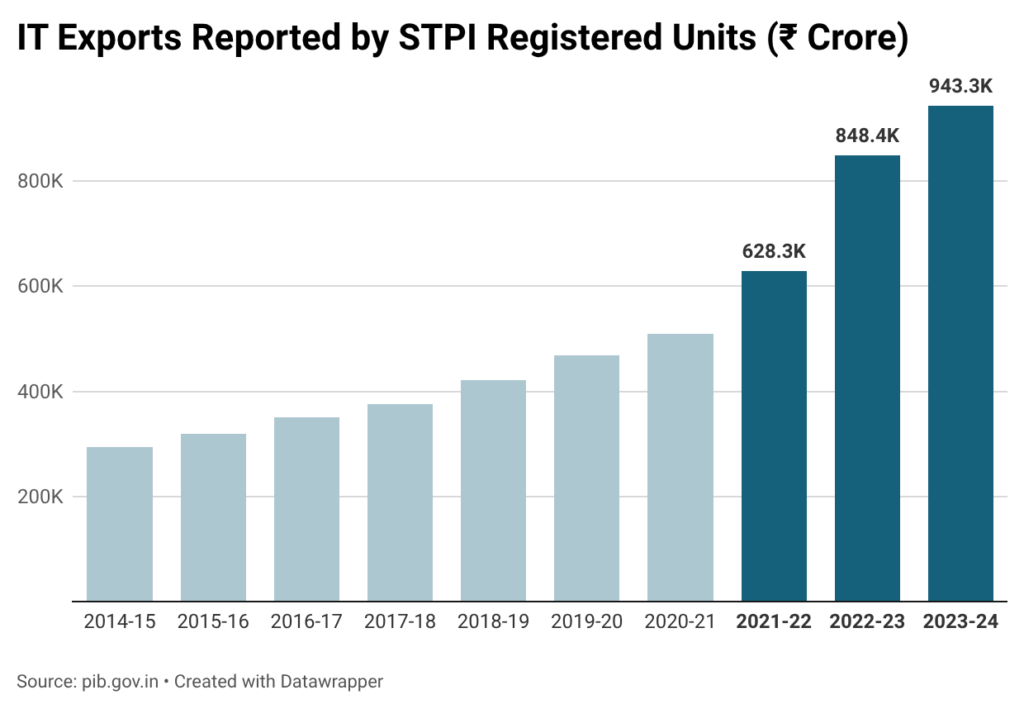
India’s Information Technology (IT) sector has undergone one of the most remarkable structural transformations in modern economic history. What once began as a modest software outsourcing destination has gradually evolved into one of the world’s largest digital services ecosystems, contributing nearly 7.5–9% of India’s GDP and generating ~$245–250 billion in annual revenue during 2025-26. The industry today functions not only as a major source of export earnings and foreign exchange inflows but also as a foundational pillar of India’s digital economy, employment ecosystem, and global economic positioning. IT services exports alone are estimated to exceed $190–205 billion annually, while the broader IT-BPM sector directly employs more than 5.4 million professionals and indirectly supports millions of additional jobs across startups, consulting networks, logistics systems, and digital platform ecosystems.
While the sector itself could be over 5 decades old, the real structural shift began after the introduction of the 1984 New Computer Policy, which significantly reduced import duties on hardware and software, liberalized imports, encouraged foreign capital, and strengthened export-oriented technology infrastructure. The inflection point came in during the Y2K transition in the late nineties and 2000, when enterprises across the United States and Europe required urgent software migration and maintenance support to prevent system failures linked to date-formatting limitations. Indian IT companies rapidly emerged as cost-efficient and technically capable partners capable of handling large-scale migration projects at speed and scale. What initially appeared to be a temporary technical opportunity soon evolved into a long-term structural outsourcing model.
“Y2K did not just solve a technical crisis it permanently repositioned India in the global technology value chain.”

Be the first to comment