
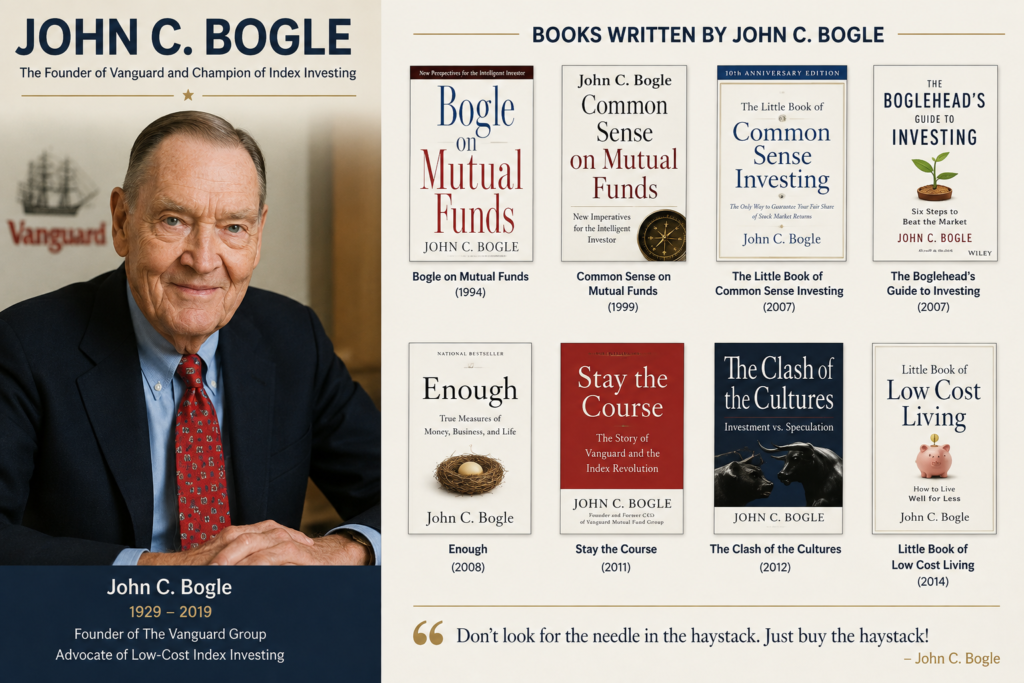
John Bogle’s investing philosophy remains one of the most influential approaches to long-term investing, built on the principles of low costs, broad diversification, disciplined investing and patience. Widely regarded as a pioneer of index mutual funds for individual investors and a major force in bringing low-cost indexing into mainstream investing, Bogle challenged the traditional belief that investors needed to identify exceptional stocks or rely on fund managers to consistently outperform the market. Instead, he argued that most investors could achieve better long-term outcomes by owning a broad share of the market, minimizing costs and allowing compounding to work over time.
The foundation of Bogle’s philosophy was his belief that costs are one of the few factors investors can control. His “cost matters” principle emphasized that management fees, trading expenses and taxes compound against investors just as returns compound in their favour. Consider a hypothetical ₹10 lakh investment earning a 10% annual gross return for 30 years. With annual costs of 0.2%, it would grow to roughly ₹1.66 crore; with costs of 1.0%, it would reach about ₹1.45 crore, a difference of roughly ₹21 lakh resulting from the higher annual cost. This illustrates why Bogle viewed fees as more than a minor expense: over long periods, they can materially reduce the wealth available to compound. This philosophy was reflected in Vanguard’s investor-owned structure and its emphasis on operating at low cost, reinforcing Bogle’s belief that investors should retain as much of the market’s return as possible.
Bogle’s approach was built around low-cost, broad-market index funds, particularly funds designed to track benchmarks such as the S&P 500. His famous principle, “Don’t look for the needle, buy the haystack,” captured the idea that investors are better served owning a broad slice of the market rather than attempting to identify a small number of future winners. By holding hundreds of companies across industries, investors could diversify company-specific risk while participating in the long-term growth of businesses and the broader economy.

Another defining feature of Bogle’s strategy was discipline over prediction. He strongly opposed market timing, short-term speculation and emotionally driven trading. Investors frequently become overly optimistic after markets rise and excessively fearful after sharp declines, often buying high and selling low. Bogle instead encouraged investors to establish an appropriate asset allocation, invest consistently and “stay the course” through market cycles. His philosophy therefore focused not only on investment selection but also on controlling investor behaviour.
Bogle’s ideas, popularized through books such as Common Sense on Mutual Funds and The Little Book of Common Sense Investing, represented a fundamental contrast to active investment philosophies. Unlike Benjamin Graham’s search for undervalued securities, Peter Lynch’s emphasis on individual companies or Warren Buffett’s focus on exceptional businesses, Bogle accepted that consistently identifying market-beating investments was extremely difficult. His objective was not to outperform the market, but to capture as much of its return as possible after costs.
However, Bogle’s philosophy is not without limitations. Broad index investing provides diversification but does not protect investors from market-wide declines, and major indexes can experience substantial losses during financial crises. Investors also remain exposed to concentration within heavily weighted indexes, meaning broad diversification does not eliminate structural risks within the benchmark itself.
Most importantly, the strategy requires behavioural discipline: investors must resist panic selling during downturns and avoid abandoning their long-term plan when active strategies or individual stocks temporarily outperform. Further, most of the index investing philosophy works better in mature or developed markets’ setting and active investing could outperform markets such as emerging or other higher growth markets such as India.
Even so, Bogle’s enduring legacy lies in demonstrating that successful investing does not necessarily require complexity, constant forecasting or aggressive trading. His philosophy helped move index investing from a controversial idea into a mainstream investment approach and inspired a global community of “Bogleheads” who follow his principles of diversification, low costs and long-term discipline. While financial markets have become more sophisticated, his central lesson remains remarkably relevant: investors do not need to outsmart the market; they need to participate in it efficiently, control what they can control and give compounding enough time to work.
Be the first to comment