

Not really a sunset industry!
The petrochemical industry remains one of the most strategically important sectors within the global industrial economy, reflecting the growing dependence of modern society on materials derived from crude oil and natural gas. Petrochemicals serve as the foundational building blocks for thousands of products used across packaging, automobiles, construction, textiles, agriculture, healthcare, electronics, and consumer goods. From polyethylene packaging and polyester fibers to fertilizers, synthetic rubber, detergents, pharmaceuticals, and advanced medical devices, petrochemical derivatives remain deeply embedded in everyday life.
Despite increasing global attention toward renewable energy and decarbonization, petrochemicals continue to represent one of the fastest-growing segments of hydrocarbon demand. According to the International Energy Agency (IEA), the sector currently consumes approximately 13 million barrels of oil per day and nearly 300 billion cubic meters of natural gas annually, accounting for roughly 14% of global oil demand and 8% of global gas consumption. More importantly, petrochemicals are expected to contribute more than one-third of global oil demand growth through 2030 and nearly half of total demand growth by 2050, making the industry increasingly important as transportation fuel demand gradually moderates.
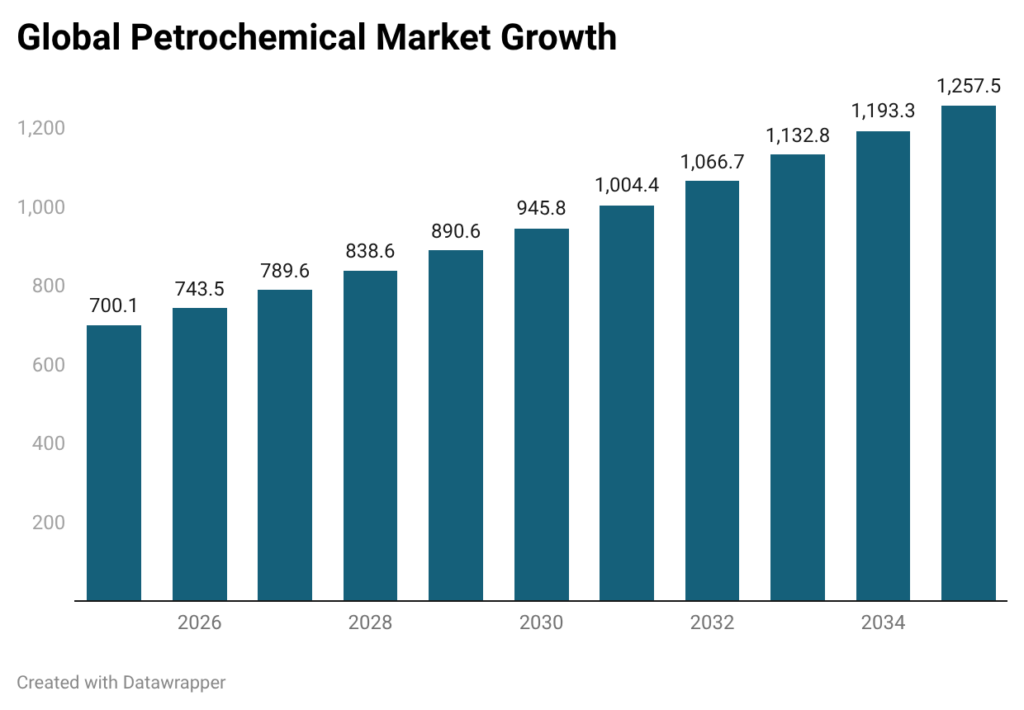
The global petrochemicals market was valued at approximately US$641 billion in 2024 and is projected to approach US$973 billion by 2030, representing a CAGR of nearly 7.3%. Beyond direct industry revenues, petrochemicals support trillions of dollars of downstream economic activity across manufacturing, infrastructure, healthcare, transportation, packaging, consumer products, and industrial production. Demand growth continues to be driven by rising urbanization, expanding middle-class consumption, infrastructure spending, industrial manufacturing, and increasing use of plastics and specialty materials across emerging economies.
Asia-Pacific remains the largest market globally, accounting for nearly 47% of total industry revenue, while China alone contributes more than one-third of regional demand. However, the industry’s future growth story may increasingly belong to India, where favorable demographics, industrial expansion, infrastructure development, and rising consumption levels are creating one of the world’s most attractive long-term petrochemical markets.
India currently consumes between 25 and 30 million metric tonnes of petrochemical products annually, while per-capita consumption remains close to 12 kilograms significantly below developed-market averages and even below several Asian peers. This consumption gap highlights substantial headroom for future growth as rising incomes, urbanization, housing development, manufacturing expansion, and infrastructure investments continue accelerating domestic demand.
A Value Chain Built on Scale
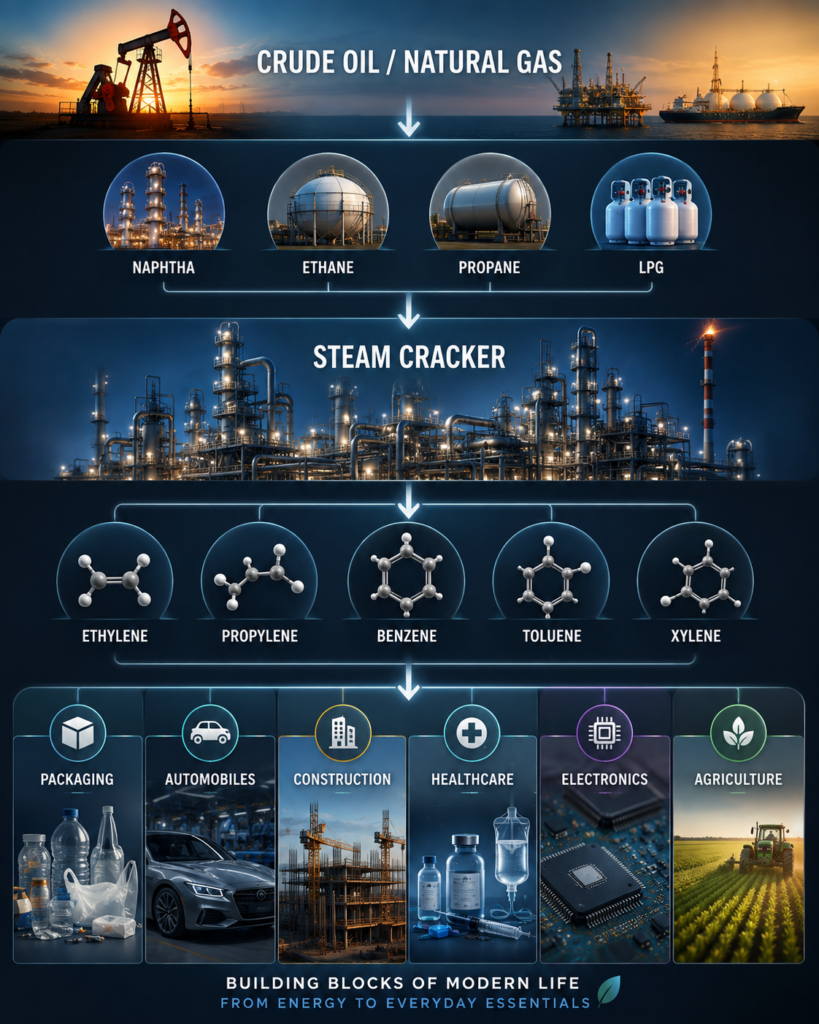
The petrochemical value chain begins with crude oil refining and natural gas processing, where feedstocks such as naphtha, ethane, propane, and liquefied petroleum gas are extracted and processed. These feedstocks are then subjected to cracking technologies that convert hydrocarbons into basic petrochemical building blocks, primarily olefins and aromatics.
Ethylene, propylene, butadiene, benzene, toluene, and xylene collectively form the foundation of the global petrochemical ecosystem. Ethylene remains the largest-volume petrochemical globally and serves as the primary raw material for polyethylene plastics, polyester fibers, industrial solvents, and numerous specialty chemicals. Propylene is widely used in polypropylene production, while aromatic compounds support manufacturing across paints, adhesives, synthetic rubber, textiles, engineering materials, and consumer products.
The scale of downstream integration supported by these products is immense. Packaging remains the largest demand segment globally, while construction, automotive manufacturing, agriculture, electronics, healthcare, and consumer products collectively account for hundreds of billions of dollars in annual petrochemical consumption.
As industries become increasingly advanced, petrochemicals are also moving beyond commodity applications. High-performance polymers, engineering plastics, specialty chemicals, battery materials, semiconductor chemicals, and advanced composites are becoming increasingly important growth segments, creating new opportunities for value-added manufacturing and innovation.
Be the first to comment